Hong Kong student's Apple tribute is Internet hit


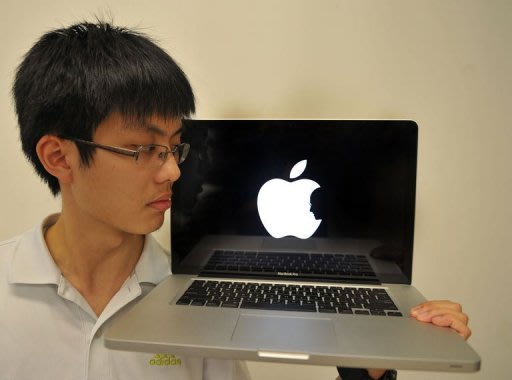
Jonathan Mak, a student at the Polytechnic University, poses with his laptop showing his self-designed logo in tribute of Apple founder Steve Jobs in Hong Kong on October 7, 2011


A Hong Kong design student said on Friday he was overwhelmed and felt "unreal" after his sombre logo in tribute to Apple founder Steve Jobs caused a worldwide Internet sensation.
The design, featuring Jobs's silhouette incorporated into the bite of a white Apple logo on a black background, has gone viral on the Internet since news of his death.
"I feel so unreal," Jonathan Mak, a second year graphic design student at Hong Kong Polytechnic University, told AFP, after he was inundated with tens of thousands of emails and messages on his Twitter account.
"You don't get to 180 thousands notes without feeling slightly insane," the 19-year-old posted on another microblogging site Tumblr Friday, referring to the messages he has received.
Mak said newspapers in the United States and Germany have contacted him about buying the copyright to use his logo and had received job offers.
"I am flattered by the attention but I would like to focus on my study before taking on any full-time job," said the bespectacled student, adding that he was trying to cope with his new-found fame.
"I'm quite busy now actually as I'm trying to finish a school project."
When asked about whether he would be targeting commercial opportunities, Mak said he was considering contacting Apple on copyright issues because his design is based on Apple's own logo.
Some merchandisers have reportedly used his logo for commemorative memorabilia for Jobs such as t-shirts and caps that are being sold on the Internet.
"I will consider using any proceeds I make from the copyright for cancer research, as suggested by some people to me on the Internet," he said. Jobs died at 56 of pancreatic cancer.
Mak said he first came up with the design after Jobs announced his resignation in late August, but the logo received little attention at the time.
The teenager said the Apple founder had inspired him in his design.
"He was a minimalist, which is the way I would like to emphasise in my design -- fewer elements but a powerful message."
"Steve Jobs strongly believed in his own ideas and continued with his beliefs no matter how people criticised him. He was courageous," said Mak.

7:28 AM | Posted in , | Read More »

Apple lost its vision eye


If you would like to share your thoughts, memories, and condolences, please email rememberingsteve@apple.com
and asloinfo@spicyindia.in

1:55 AM | Posted in , , | Read More »

Apple announces death of Steve Jobs


NEW YORK: Apple on Wednesday announced the death of its visionary co-founder Steve Jobs.

"We are deeply saddened to announce that Steve Jobs passed away today," the company's board of directors said in a statement.

"Steve's brilliance, passion and energy were the source of countless innovations that enrich and improve all of our lives. The world is immeasurably better because of Steve."

The Silicon Valley icon who gave the world the iPod and the iPhone resigned as CEO of the world's largest technology corporation in August, handing the reins to current chief executive Tim Cook.


Jobs had battled cancer in 2004 and underwent a liver transplant in 2009 after taking a leave of absence for unspecified health problems. He took another leave of absence in January, his third since his health problems began, before resigning as CEO six weeks ago. Jobs became Apple's chairman and handed the CEO job over to his hand-picked successor, Tim Cook.

The news Apple fans and shareholders had been dreading came the day after Apple unveiled its latest version of the iPhone, just one in a procession of devices that shaped technology and society while Jobs was running the company.

Jobs started Apple with a high school friend in a Silicon Valley garage in 1976, was forced out a decade later and returned in 1997 to rescue the company. During his second stint, it grew into the most valuable technology company in the world with a market value of $351 billion. OnlyExxon Mobil, which makes it money extracting and refining oil instead of ideas, is worth more.

Cultivating Apple's countercultural sensibility and a minimalist design ethic, Jobs rolled out one sensational product after another, even in the face of the late-2000s recession and his own failing health.


He helped change computers from a geeky hobbyist's obsession to a necessity of modern life at work and home, and in the process he upended not just personal technology but the cellphone and music industries. For transformation of American industry, he ranks among his computer-age contemporary, Microsoft Corp. co-founder Bill Gates and other creative geniuses such as Walt Disney that left an indelible imprint on the world. Jobs died as Walt Disney Co.'s largest shareholder, a by-product of his decision to sell computer animation studio Pixar in 2006.

Perhaps most influentially, Jobs in 2001 launched the iPod, which offered "1,000 songs in your pocket." Over the next 10 years, its white earphones and thumb-dial control seemed to become more ubiquitous than the wristwatch.

In 2007 came the touch-screen iPhone, joined a year later by Apple's App Store, where developers could sell iPhone "apps" which made the phone a device not just for making calls but also for managing money, editing photos, playing games and social networking. And in 2010, Jobs introduced the iPad, a tablet-sized, all-touch computer that took off even though market analysts said no one really needed one.

Steven Paul Jobs was born Feb. 24, 1955, to Joanne Simpson, then an unmarried graduate student, and Abdulfattah Jandali, a student from Syria. Simpson gave Jobs up for adoption, though she married Jandali and a few years later had a second child with him, Mona Simpson, who became a novelist.

Steven was adopted by Clara and Paul Jobs of Los Altos, Calif., a working-class couple who nurtured his early interest in electronics. He saw his first computer terminal at NASA's Ames Research Center when he was around 11 and landed a summer job at Hewlett-Packard before he had finished high school.

Jobs enrolled in Reed College in Portland, Ore., in 1972 but dropped out after a semester.

"All of my working-class parents' savings were being spent on my college tuition. After six months, I couldn't see the value in it," he said at a Stanford University commencement address in 2005. "I had no idea what I wanted to do with my life and no idea how college was going to help me figure it out."

When he returned to California in 1974, Jobs worked for video game maker Atari and attended meetings of the Homebrew Computer Club with Steve Wozniak, a high school friend who was a few years older.

Wozniak's homemade computer drew attention from other enthusiasts, but Jobs saw its potential far beyond the geeky hobbyists of the time. The pair started Apple in Jobs' parents' garage in 1976. Their first creation was the Apple I - essentially, the guts of a computer without a case, keyboard or monitor.

The Apple II, which hit the market in 1977, was their first machine for the masses. It became so popular that Jobs was worth $100 million by age 25. Time magazine put him on its cover for the first time in 1982.

During a 1979 visit to the Xerox Palo Alto Research Center, Jobs again spotted mass potential in a niche invention: a computer that allowed people to access files and control programs with the click of a mouse, not typed commands. He returned to Apple and ordered the team to copy what he had seen.

It foreshadowed a propensity to take other people's concepts, improve on them and spin them into wildly successful products. Under Jobs, Apple didn't invent computers, digital music players or smartphones - it reinvented them for people who didn't want to learn computer programming or negotiate the technical hassles of keeping their gadgets working.

"We have always been shameless about stealing great ideas," Jobs said in an interview for the 1996 PBS series "Triumph of the Nerds."

The engineers responded with two computers. The pricier one, called Lisa, launched to a cool reception in 1983. A less-expensive model called the Macintosh, named for an employee's favorite apple, exploded onto the scene in 1984.

The Mac was heralded by an epic Super Bowl commercial that referenced George Orwell's "1984" and captured Apple's iconoclastic style. In the ad, expressionless drones marched through dark halls to an auditorium where a Big Brother-like figure lectures on a big screen. A woman in a bright track uniform burst into the hall and launched a hammer into the screen, which exploded, stunning the drones, as a narrator announced the arrival of the Mac.

There were early stumbles at Apple. Jobs clashed with colleagues and even the CEO he had hired away from Pepsi, John Sculley. And after an initial spike, Mac sales slowed, in part because few programs had been written for the new graphical user interface .

Meanwhile, Microsoft copied the Mac approach and introduced Windows, outmaneuvering Apple by licensing its software to slews of computer makers while Apple insisted on making its own machines.

Software developers wrote programs first for Windows because it had millions more computers . A Mac version didn't come for months, if at all.

With Apple's stock price sinking, conflicts between Jobs and Sculley mounted. Sculley won over the board in 1985 and pushed Jobs out of his day-to-day role leading the Macintosh team. Jobs resigned his post as chairman of the board and left Apple within months.

"What had been the focus of my entire adult life was gone, and it was devastating," Jobs said in his Stanford speech. "I didn't see it then, but it turned out that getting fired from Apple was the best thing that could have ever happened to me. The heaviness of being successful was replaced by the lightness of being a beginner again, less sure about everything. It freed me to enter one of the most creative periods of my life."

He got into two other companies: Next, a computer maker, and Pixar, a computer-animation studio that he bought from George Lucas for $10 million.

Pixar, ultimately the more successful venture, seemed at first a bottomless money pit. Then came "Toy Story," the first computer-animated full-length feature. Jobs used its success to negotiate a sweeter deal with Disney for Pixar's next two films. In 2006, Jobs sold Pixar to The Walt Disney Co. for $7.4 billion in stock, making him Disney's largest individual shareholder and securing a seat on the board.

With Next, Jobs was said to be obsessive about the tiniest details of the cube-shaped computer, insisting on design perfection even for the machine's guts. He never managed to spark much demand for the machine, which cost a pricey $6,500 to $10,000.

Ultimately, he shifted the focus to software - a move that paid off later when Apple bought Next for its operating system technology, the basis for the software still used in Mac computers.

By 1996, when Apple bought Next, Apple was in dire financial straits. It had lost more than $800 million in a year, dragged its heels in licensing Mac software for other computers and surrendered most of its market share to PCs that ran Windows.

Larry Ellison, Jobs' close friend and fellow Silicon Valley billionaire and the leader of Oracle Corp., publicly contemplated buying Apple in early 1997 and ousting its leadership. The idea fizzled, but Jobs stepped in as interim chief later that year.

He slashed unprofitable projects, narrowed the company's focus and presided over a new marketing push to set the Mac apart from Windows, starting with a campaign encouraging computer users to "Think different."

"In the early days, he was in charge of every detail. The only way you could say it is, he was kind of a control freak," he said. In his second stint, "he clearly was much more mellow and more mature."

In the decade that followed, Jobs kept Apple profitable while pushing out an impressive roster of new products.

Apple's popularity exploded in the 2000s. The iPod, smaller and sleeker with each generation, introduced many lifelong Windows users to their first Apple gadget.

ITunes, in 2003, gave people a convenient way to buy music legally online, song by song. For the music industry, it was a mixed blessing. The industry got a way to reach Internet-savvy people who, in the age of Napster, were growing accustomed to downloading music free. But online sales also hastened the demise of CDs and established Apple as a gatekeeper, resulting in battles between Jobs and music executives over pricing and other issues.

Jobs' command over gadget lovers and pop culture swelled to the point that, on the eve of the iPhone's launch in 2007, faithful followers slept on sidewalks outside posh Apple stores for the chance to buy one. Three years later, at the iPad's debut, the lines snaked around blocks and out through parking lots, even though people had the option to order one in advance.

The decade was not without its glitches. Apple was swept up in a Securities and Exchange Commission inquiry into stock-options backdating in the mid-2000s, a practice that artificially boosted the value of options grants. But Jobs and Apple emerged unscathed after two former executives took the fall and eventually settled with the SEC.

Jobs' personal ethos - a natural food lover who embraced Buddhism and New Age philosophy - was closely linked to the public persona he shaped for Apple. Apple itself became a statement against the commoditization of technology - a cynical view, to be sure, from a company whose computers can cost three or more times as much as those of its rivals.

For technology lovers, buying Apple products meant gaining entrance to an exclusive club. At the top was a complicated and contradictory figure who was endlessly fascinating - even to his detractors, of which Jobs had many. Jobs was a hero to techno-geeks and a villain to partners he bullied and to workers whose projects he unceremoniously killed or claimed as his own.

Unauthorized biographer Alan Deutschman described him as "deeply moody and maddeningly erratic." In his personal life, Jobs denied for two years that he was the father of Lisa, the baby born to his longtime girlfriend Chrisann Brennan in 1978.

Few seemed immune to Jobs' charisma and will. He could adeptly convince those in his presence of just about anything - even if they disagreed again when he left the room and his magic wore off.

"He always has an aura around his persona," said Bajarin, who met Jobs several times while covering the company for more than 20 years as a Creative Strategies analyst. "When you talk to him, you know you're really talking to a brilliant mind."

But Bajarin also remembers Jobs lashing out with profanity at an employee who interrupted their meeting. Jobs, the perfectionist, demanded greatness from everyone at Apple.

Jobs valued his privacy, but some details of his romantic and family life have been uncovered. In the early 1980s, Jobs dated the folk singer Joan Baez, according to Deutschman.

In 1989, Jobs spoke at Stanford's graduate business school and met his wife, Laurene Powell, who was then a student. When she became pregnant, Jobs at first refused to marry her. It was a near-repeat of what had happened more than a decade earlier with then-girlfriend Brennan, Deutschman said, but eventually Jobs relented.

Jobs started looking for his biological family in his teens, according to an interview he gave to The New York Times in 1997. He found his biological sister when he was 27. They became friends, and through her Jobs met his biological mother. Few details of their relationships have been made public.

But the extent of Apple secrecy didn't become clear until Jobs revealed in 2004 that he had been diagonosed with - and "cured" of - a rare form of operable pancreatic cancer called an islet cell neuroendocrine tumor. The company had sat on the news of his diagnosis for nine months while Jobs tried trumping the disease with a special diet, Fortune magazine reported in 2008.

In the years after his cancer was revealed, rumors about Jobs' health would spark runs on Apple stock as investors worried the company, with no clear succession plan, would fall apart without him. Apple did little to ease those concerns. It kept the state of Jobs' health a secret for as long as it could, then disclosed vague details when, in early 2009, it became clear he was again ill.

Jobs took a half-year medical leave of absence starting in January 2009, during which he had a liver transplant. Apple did not disclose the procedure at the time; two months later, The Wall Street Journal reported the fact and a doctor at the transplant hospital confirmed it.

In January 2011, Jobs announced another medical leave, his third, with no set duration. He returned to the spotlight briefly in March to personally unveil a second-generation iPad .

In 2005, following the bout with cancer, Jobs delivered Stanford University's commencement speech.

"Remembering that I'll be dead soon is the most important tool I've ever encountered to help me make the big choices in life," he said. "Because almost everything - all external expectations, all pride, all fear of embarrassment or failure - these things just fall away in the face of death, leaving only what is truly important." 

1:49 AM | Posted in , , , , | Read More »

Google's 13th Birthday- We wish Happy Birthday to Google.

Google celebrates 13th birthday with Google Doodle


Google Inc. is an American multinational public corporation invested in Internet search, cloud computing, and advertising technologies. Google hosts and develops a number of Internet-based services and products, and generates profit primarily from advertising through its AdWords program. The company was founded by Larry Page and Sergey Brin, often dubbed the "Google Guys", while the two were attending Stanford University as PhD candidates. It was first incorporated as a privately held company on September 4, 1998, and its initial public offering followed on August 19, 2004. At that time Larry Page, Sergey Brin, and Eric Schmidt agreed to work together at Google for twenty years, until the year 2024. The company's mission statement from the outset was "to organize the world's information and make it universally accessible and useful",and the company's unofficial slogan – coined by Google engineer Amit Patel  and supported by Paul Buchheit – is "Don't be evil". In 2006, the company moved to its current headquarters in Mountain View, California.
It has been estimated that Google runs over one million servers in data centers around the world, and processes over one billion search requests  and about twenty-four petabytes of user-generated data every day. Google's rapid growth since its incorporation has triggered a chain of products, acquisitions, and partnerships beyond the company's core web search engine. The company offers online productivity software, such as its Gmail email service, and social networking tools, including orkut and, more recently, Google Buzz and Google+. Google's products extend to the desktop as well, with applications such as the web browser Google Chrome, the Picasa photo organization and editing software, and the Google Talk instant messaging application. Notably, Google leads the development of the Android mobile operating system, used on a number of phones such as the Motorola Droid and the Samsung Galaxy smart phone series', as well as the new Google Chrome OS  best known as the main operating system on the Cr-48 and also, since 15 June 2011, on commercial Chrome books such as the Samsung Series 5  and Acer AC700. Alexa lists the main U.S.-focused google.com site as the Internet's most visited website, and numerous international Google sites (google.co.in(14) is the most visited site in India, google.co.uk in the U.K, etc.) are in the top hundred, as are several other Google-owned sites such as YouTube (Alexa:3), Blogger(Alexa:6), and Orkut. Google also ranks number two in the BrandZ brand equity database. The dominant market position of Google's services has led to criticism of the company over issues including privacy, copyright, and censorship. 

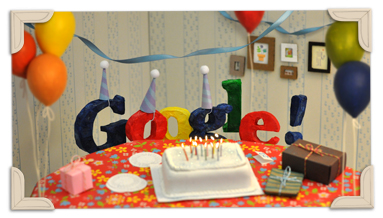
The search engine marks entering its teens by turning its home page into a birthday party scene.
Surrounded by multi-coloured balloons and streamers, its logo is adorned with party hats and sits behind a table heaped with wrapped presents and a large white birthday cake with 13 candles.
Although Google's founders, Stanford University graduate students Larry Page and Sergey Brin, built their first search engine in 1996, it was not until 1998 that they formalised their work and created Google.
The company filed for incorporation on September 4, 1998, and the Google.com domain was registered on September 15. The search engine officially celebrates its birthday on September 27.
The pair came up with the name as a play on the word “googol”, the mathematical term for a 1 followed by 100 zeros.

8:00 AM | Posted in , , | Read More »

Our brain keeps growing well into our 20s

Toronto: Our brain continues to grow well into our 20s -- not just stopping at adolescence as once thought in medical science.

New evidence to this effect has been unearthed by biomedical engineering researchers Christian Beaulieu and his doctoral student Catherine Lebel, from University of Alberta in Canada.

Lebel recently moved to the US to work at the University of California in Los Angeles where she is a post-doctoral fellow working with an expert in brain-imaging research.

"This is the first long-range study using a type of imaging that looks at brain wiring to show that in the white matter, there are still structural changes happening during young adulthood," says Lebel, the Journal of Neuroscience reports.

"The white matter is the wiring of the brain; it connects different regions to facilitate cognitive abilities. So the connections are strengthening as we age in young adulthood," Lebel added, according to an Alberta statement.

The researchers relied on magnetic resonance imaging (MRIs) to scan the brains of 103 healthy people aged between five and 32 years.

Each subject was scanned at least twice, with a total of 221 scans being conducted overall. The study demonstrated that parts of the brain continue to develop post-adolescence within individual subjects.

The results revealed that young adult brains were still wiring the frontal lobe; tracts responsible for complex cognitive tasks such as inhibition, high-level functioning and attention.

Researchers speculated that this may be due to a plethora of life experiences in young adulthood, such as pursuing post-secondary education, starting a career, independence and developing new social and family relationships.

"What's interesting is a lot of psychiatric illness and other disorders emerge during adolescence... it may be one of the factors that makes someone more susceptible to developing these disorders," says Beaulieu.

1:41 AM | Posted in , , | Read More »

Web users locate two new potential planets

Washington: Forty thousand web users worldwide have been assisting astronomers analyze light from 150,000 stars in hopes of finding earth-like or exoplanets. Now the web users have discovered two such potential plants.

Citizen scientists, under the project Planet Hunters launched last December, analyzed real scientific data collected by NASA's Kepler mission. The mission has been searching for planets beyond our own solar system - called exoplanets, since its launch in March 2009.

The astronomers at the Yale University have announced the first two potential exoplanets discovered by Planet Hunters users, the journal Monthly Notices of the Royal Astronomical Society reports.

"This is the first time that the public has used data from a NASA space mission to detect possible planets orbiting other stars," said Yale astronomer Debra Fischer, who helped launch the Planet Hunters project.

The candidate planets orbit their host stars with periods ranging from 10 to 50 days - much shorter than the 365 days it takes the Earth to orbit the Sun - and have radii that range in size from two-and-a-half to eight times the Earth's radius, according to a NASA statement.

Despite those differences, one of the two candidates could be a rocky planet similar to the size of the Earth (as opposed to a giant gas planet like Jupiter), although they aren't in the so-called "habitable zone" where water and therefore life as we know it, could exist.

Next, the Planet Hunters team used the W.M. Keck Observatory in Hawaii to analyze the host stars.

"I think there's a 95 per cent chance or greater that these are bona fide planets," Fischer said.

"These. . . candidates might have gone undetected without Planet Hunters and its citizen scientists," said Meg Schwamb, Yale researcher and Planet Hunters co-founder.

"Obviously Planet Hunters doesn't replace the analysis being done by the Kepler team. But it has proven itself to be a valuable tool in the search for other worlds," added Schwamb.

1:40 AM | Posted in , , | Read More »

Japan robot to attempt Hawaii triathlon


After scaling the cliff walls of the Grand Canyon and driving the Le Mans racetrack for 24 hours, a tiny Japanese robot is set for a new challenge -- Hawaii's grueling Ironman Triathlon course. (Reuters)


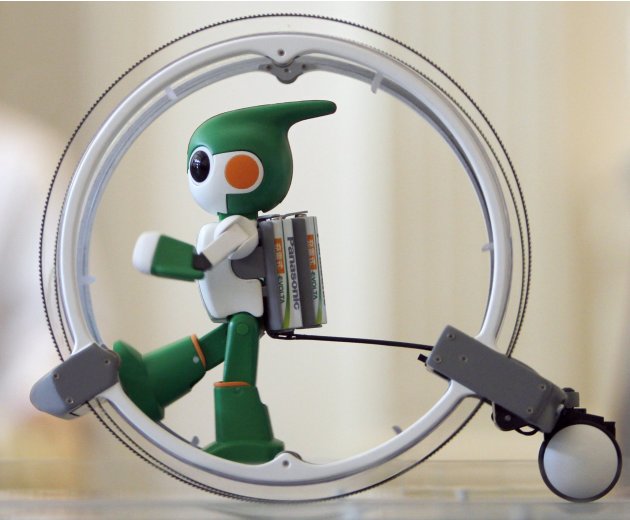
Panasonic's "Evolta" run robot, powered by the company's Evolta rechargable batteries, is demonstrated during a news conference in Tokyo September 15, 2011. The company said three types of Evolta robots, developed to swim, bike and run, will challenge to complete an Ironman triathlon course in Hawaii, a total of about 230 km, within one week or 168 hours from October 24, 2011, powered by three AA-size rechargeable Evolta batteries, the company said. REUTERS/Yuriko Nakao (JAPAN - Tags: SCIENCE TECHNOLOGY


Panasonic's "Evolta" bike robot, powered by the company's Evolta rechargable batteries, is demonstrated during a news conference in Tokyo September 15, 2011. The company said three types of Evolta robots, developed to swim, bike and run, will challenge to complete an Ironman triathlon course in Hawaii, a total of about 230 km, within one week or 168 hours from October 24, 2011, powered by three AA-size rechargeable Evolta batteries, the company said. REUTERS/Yuriko Nakao (JAPAN - Tags: SCIENCE TECHNOLOGY


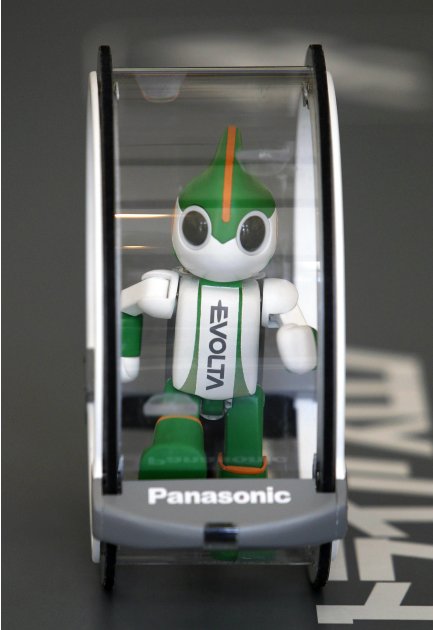
 Panasonic's "Evolta" swim robot, powered by the company's Evolta rechargable batteries, is demonstrated at a pool during a news conference in Tokyo September 15, 2011. The company said three types of Evolta robots, developed to swim, bike and run, will challenge to complete an ironman triathlon course in Hawaii, a total of about 230 km, within one week or 168 hours from October 24, 2011, powered by three AA-size rechargeable Evolta batteries, the company said. REUTERS/Yuriko Nakao (JAPAN - Tags: SCIENCE TECHNOLOGY

Panasonic's "Evolta" run robot, powered by the company's Evolta rechargable batteries, is demonstrated during a news conference in Tokyo September 15, 2011. The company said three types of Evolta robots, developed to swim, bike and run, will challenge to complete an Ironman triathlon course in Hawaii, a total of about 230 km, within one week or 168 hours from October 24, 2011, powered by three AA-size rechargeable Evolta batteries, the company said. REUTERS/Yuriko Nakao (JAPAN - Tags: SCIENCE TECHNOLOGY)


Panasonic's "Evolta" swim robot, powered by the company's Evolta rechargable batteries, is demonstrated at a pool during a news conference in Tokyo September 15, 2011. REUTERS/Yuriko Nakao

8:04 AM | Posted in , | Read More »

ISRO Develops Supercomputer SAGA-220


Thiruvananthapuram : Indian Space Research Organization 

has built a supercomputer "SAGA-220", which is to be India’s fastest in terms of theoretical peak performance of 220 TeraFLOPS (220 Trillion Floating Point Operations per second).

The supercomputer "SAGA-220", built by the Satish Dhawan 
Supercomputing Facility located at Vikram Sarabhai Space Centre (VSSC), Thiruvananthapuram at a cost of about Rs 14 crore was inaugurated by K Radhakrishnan, 
Chairman ISRO at VSSC today, ISRO said in a statement.

The new Graphic Processing Unit (GPU) based supercomputer,    "SAGA-220" (Supercomputer 
for Aerospace with GPU Architecture-220 TeraFLOPS) is being used by space scientists for solving complex aerospace problems.

"SAGA-220” is fully designed and built by Vikram Sarabhai Space Centre using commercially available hardware, open source software components and in house developments.
The system uses 400 NVIDIA Tesla 2070 GPUs and 400 Intel Quad Core Xeon CPUs supplied by WIPRO with a high speed interconnect.With each GPU and CPU providing a performance of 500 GigaFLOPS and 50 GigaFLOPS respectively, the theoretical peak performance of the system amounts to 220 TeraFLOPS, the statement said.

The present GPU system offers significant advantage over the conventional CPU based system in terms of cost, power and space requirements, it said.

The system is environmentally green and consumes a power 


1:31 AM | Posted in , , , , , | Read More »

Modern Inventions 2000 - 2009

                                 Modern Inventions

                                     2000 - 2009

Modern Inventions of 2000

·                        The mystery of Ginger.
·                        Environmentally friendly transformer fluid from vegetable oils invented by T.V. Oommen.
·                        FluidSense infusion pump invented (automatic and standardized intravenous applicator).

Modern Inventions of 2001

·                        AbioCor artificial heart invented by Abiomed - the Abiocor represents groundbreaking medical miniaturization technology. Nuvaring birth control invented by Organon.
·                        Artificial liver invented by Dr. Kenneth Matsumura and Alin Foundation.
·                        Fuel cell bike invented by Aprilia.
·                        Self-cleaning windows invented by PPG Industries.
·                        On October 23, 2001 Apple Computers publicly announced their portable music digital player theiPod, created under project codename Dulcimer.
·                        Time Magazine Modern Inventions of the Year 2001

Modern Inventions of 2002

·                        Braille Glove invented by Ryan Patterson.
·                        Phone tooth invented by James Auger and Jimmy Loizeau.
·                        Nano-tex - nanotechnology wearable fabrics invented by Nano-tex LLC.
·                        Birth control patch invented by Ortho McNeil Pharmaceutical.
·                        Foveon Camera Chip invented by Richard Merrill.
·                        Date Rape Drug Spotter invented by Francisco Guerra.
·                        Solar Tower invented by Jorg Schlaich.
·                        Virtual keyboard invented by Canesta and VKB.
·                        ICOPOD invented by Sanford Ponder.
·                        Time Magazine Modern Inventions of the Year 2002

Modern Inventions of 2003

·                        Optical Camouflage System invented by Susumu Tachi, Masahiko Inami, and Naoki Kawakami
·                        Toyota's Hybrid Car
·                        Ice Bike invented by Dan Hanebrink
·                        New Toy Robots Max the robotic cat invented by Omron, LUCKY, THE ROVING ROBO-RAPTOR invented by Walt Disney Imagineering, and Sony builds Aibo a companion calledOrio.
·                        New Fabrics, Salmon Skin Leather invented by Claudia Escobar and Skini, and Luminex a glowing fabric invented by Luminex.
·                        Java Log a log for your fireplace made from used coffee grinds and invented by Rod Sprules
·                        Infrared Fever Screening System used in public buildings to scan for people with a high temperature from a fever or sars invented bySingapore Technologies Electronics and the Singapore Defense Science and Technology Agency
·                        The No-Contact Jacket invented by Adam Whiton and Yolita Nugent, protects the wearer by electric shocking any attackers.
·                        Time Magazine Modern Inventions of the Year 2003
·                        Popular Science Best of What's New 2003

Modern Inventions of 2004

·                        Adidas 1 are the thinking shoes with a built in microprocessor that decides how soft or firm support the wearer needs. Chosen by Popular Science magazine as the best recreation invention of 2004.
·                        Translucent Concrete developed by Hungarian architect Aron Losonczi and calledLitraCon and is based on a matrix of parallel optical glass fibers embedded into the concrete that can transmit light and color from the outside. However, this is not the only translucent concrete out there. Inventor Bill Price has been developing another variety.
·                        Ka-on or Flower Sound are plants that play music invented by the Japanese based Let's Corporation. Flowers bouquets will act as loudspeakers when placed in a special vase that has electronics hidden in the base.
·                        Intel Express Chipsets - Grantsdale and Alderwood are the code names of Intel's newest chips that will provide superior and inexpensive built-in sound and video capacities for the PC including the ability to do high definition video editing without additional computer cards.
·                        SonoPrep invented by bioengineer Robert Langer, is a device that will deliver medication by sound waves rather than injection. According to the Sontra Medical Corporation, SonoPrep's manufacturer: The small, battery-powered device applies low-frequency ultrasonic energy to the skin for 15 seconds. The ultrasound temporarily rearranges lipids in the skin, opening channels that let fluids be delivered or extracted. After about 24 hours, the skin returns to normal.
·                        Popular Science Best of What's New 2004
·                        Time Magazine Modern Inventions of the Year 2004

Modern Inventions of 2005

·                        YouTube - the online video sharing and viewing community - was invented in 2005 by Steve Chen, Chad Hurley and Jawed Karim. YouTube was named Time Magazines Invention of the year in 2006.
·                        Time Magazine Modern Inventions of the Year 2005

Modern Inventions of 2006

·                        Time Magazine Modern Inventions of the Year 2006
·                        Popular Science Best of What's New 2006

Modern Inventions of 2007

·                        Time Magazine Modern Inventions of the Year 2007
·                        Popular Science Best of What's New 2007

Modern Inventions of 2008

New inventions of 2008 include: smog-earing cement, high altitude flying windmills, bionic contacts, pig-urine plastic.
·                        Inventors' Pick for Top Inventions of 2008
·                        Time Magazine Modern Inventions of the Year 2008
·                        Popular Science Best of What's New 2008

Modern Inventions of 2009

New inventions of 2009 include: a new computer interface called the sixth sense, and a retinal implant for the blind.
·                        Inventors' Pick for 

1:01 AM | Posted in , , , , | Read More »